.png)
Uncovering the Legacy of Redlining: How Housing Discrimination Shaped Communities
In the 1930s, as part of housing reforms connected to the New Deal, the newly created Home Owners’ Loan Corporation (HOLC) made color-coded maps to represent perceived mortgage risks neighborhood by neighborhood. From best to worst, neighborhoods were colored green, blue, yellow, or red. Neighborhoods inhabited mainly by racial minorities (especially black people), immigrants, or the working class in general were marked red and deemed “hazardous.” Greater Boston was considered one of the cities most affected by redlining. Below is a map of neighborhoods in part of the Greater Boston area, as originally categorized by the HOLC in the 1930s.
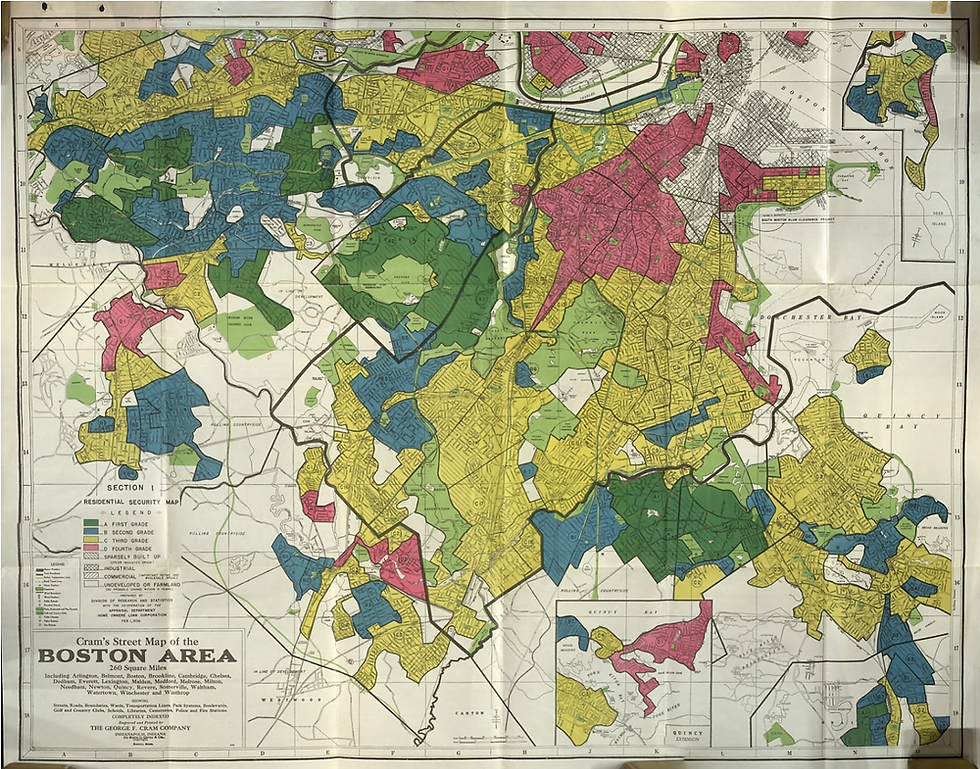
If they were marked red, it became nearly impossible for residents of neighborhoods to access financial services. The Federal Housing Administration (FHA) refused to insure homes there, and private banks refused to back mortgages. Businesses crucial to local development, like grocery stores, moved their operations elsewhere. As such, redlining is generally defined as the systematic practice of denying financial services, such as home credit or insurance, to people from certain neighborhoods based on their race.
The presence of black people in an area almost automatically meant a lower rating by HOLC. Despite easy public transit access and a thriving school system, areas in West Roxbury were marked red due to “the infiltration of Negros.” This meant that not only were racial minorities like Black people adversely affected by redlining, but white people were now incentivized to keep black people out of their neighborhoods. Thus, a system of informal segregation came into effect. The visible effects of redlining are therefore also often clearly divided by race.
All of the factors mentioned above led neighborhoods like those in my home state of Massachusetts to be trapped in a cycle of poverty. The lack of access to legitimate loans forced many to turn to predatory lending contracts, which in turn led to widespread property abandonment. The affected neighborhoods’ lack of other business opportunities led to them being seen as more expendable. As such, they were often the most affected by industrial development and highway construction, which have adversely impacted residents’ health and led to a lack of green space. In New York, formerly D-graded neighborhoods are located near approximately 2 times as many oil and gas wells as formerly A-graded areas. Proximity to these wells increases residents’ chances of cardiovascular diseases, lung problems, anxiety, preterm birth, and depression.
Addressing the issue of redlining is challenging, but with targeted legislation and active community efforts, it can be overcome. Understanding the problem is a crucial first step, and I hope this article has laid that foundation.
Sources:
About the Author
Oliver Chi is a leader of the BranchOut! Newton Chapter. As a junior at Newton North High School in Newton, MA, he has a strong interest in history and community involvement. Through AmeriCorps, he assisted with the 2024 election by guiding voters through procedures and supporting the overall process. Oliver is a member of Newton North’s varsity History Team. He wrote an independent research paper on the impact of the War of 1812 on American nationalism, which was later published in the American Journal of Student Research.


Comments