.png)
Boston Runs on Dunkin’—and the MBTA. Here’s Why I Still Believe in It.
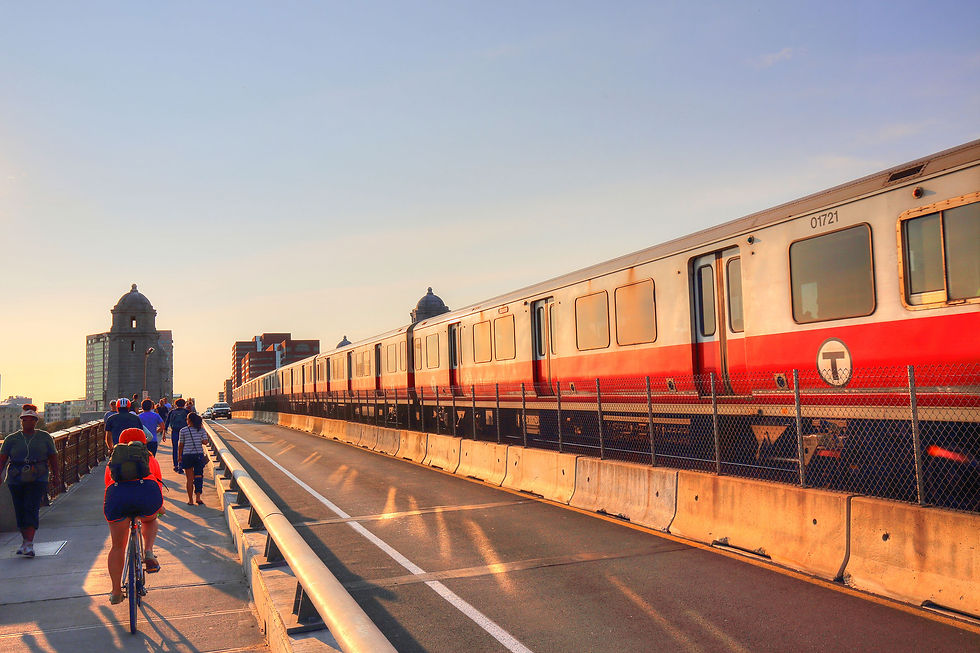
Boston may run on Dunkin’, but it also runs on the MBTA. The Massachusetts Bay Transportation Authority has evolved throughout its half-century of existence (although predecessor systems date back to 1834). It includes the oldest subway in America and the third-oldest in the world, making it one of the longest-running and most expansive public transit systems in the United States.
Which makes its history of unreliability all the more baffling.
The MBTA is divided into the Commuter Rail (which mostly runs services between the city and the suburbs at rush hour), dozens of bus lines, a ferry service connecting Boston, the Harbor Islands, and neighboring coastal cities, and several rapid transit lines. The subway itself is divided into the Red (including a streetcar to Mattapan), Orange, Blue, and Green Lines (including the B, C, D, and E branches; the A branch was taken out of service in the 1960s).
A History Off the Rails
Until recently, the service was notoriously awful, hitting an all-time low during and after the pandemic. A 2021 collision on the Green Line injured 25 passengers. A man died on the Red Line the following year after he was caught in the doors and dragged by the train. Several heavy ceiling panels collapsed at Harvard Square in 2023, nearly hitting a passenger.
Most infamously, 200 people were evacuated from an Orange Line train after it caught fire over the Mystic River. Unable to open the emergency exit, passengers were forced to climb out through the windows. The delays became so legendary that people recently made it a viral challenge to see if they could outrun the Green Line on foot (which they usually could).
Even now, some inconveniences remain. Even when the Green Line isn’t blowing out my eardrums with its incessant squeaking all the way into Boylston, various branches face weekend closures for long-overdue upgrades. With signal work scheduled for this coming weekend, I'll have to find a Plan B to get into the city. Nonetheless, this shows work is being done, and the system is improving, albeit slowly.
Turning the Corner: Real Progress and Expansion
And it has made notable improvements. Under MBTA General Manager Phil Eng—and following severe directives from the Federal Transit Administration (FTA)—the system has begun to thoroughly renovate its ancient infrastructure. Crews are eliminating "slow zones" that restricted reliability, modernizing signals and tracks, ordering new buses and trains, and instituting fare gates at stations to bring in essential revenue.
This work has produced real results:
Orange Line: On-time reliability has increased from 75% to 97%.
Red Line: On-time reliability has jumped from 43% to 86%.
In addition, accessibility upgrades are ongoing throughout the Commuter Rail system, including replacing or repairing century-old rail bridges. Low-floor, accessible buses are replacing older models, and a new app lets riders track trains and buses in real time while receiving disruption alerts.
The system is expanding, too. The Green Line Extension brought service to Union Square in Somerville and Tufts University in Medford, while the South Coast Rail project extended commuter service along formerly abandoned lines in southern Massachusetts—bringing Fall River and New Bedford their first passenger service since 1958.
Looking Ahead in My Hometown
In my area, the Newtonville commuter rail station is currently one long strip of asphalt by the trackside with a bare-bones shelter, positioned down a long flight of stairs that makes it completely inaccessible to riders with disabilities—a flaw shared by the two other stations in my hometown of Newton. However, an ambitious construction project will add elevators, a second platform for outbound trains, and a bridge between the two, alongside track realignment to accommodate them. Even though construction is scheduled for three years, I find myself hoping against hope for the system’s future.
The MBTA may not be as advanced or reliable as some of the other transit systems in the world—or even in the U.S.—but it’s there for me on outings with my friends, for study sessions at the Boston Public Library, for baseball games at Fenway, and for Patriots games in Foxborough. It gets me where I need to go.
Even though it lets me down sometimes—I once waited at a bus stop for thirty minutes in the pouring rain—the imperfections are part of the charm, like an aging dog that still leaps and bounds after a ball. I hope those issues become nothing more than minor imperfections in the future. With the MBTA currently seeking public feedback for its Focus 2050 agenda, there is still a bright future ahead for this old system.
About the Author
Oliver Chi is a leader of the BranchOut! Newton Chapter. As a senior at Newton North High School in Newton, MA, he has a strong interest in history and community involvement. Through AmeriCorps, he assisted with the 2024 election by guiding voters through procedures and supporting the overall process. Oliver is a member of Newton North’s varsity History Team. He wrote an independent research paper on the impact of the War of 1812 on American nationalism, which was later published in the American Journal of Student Research.


Comments